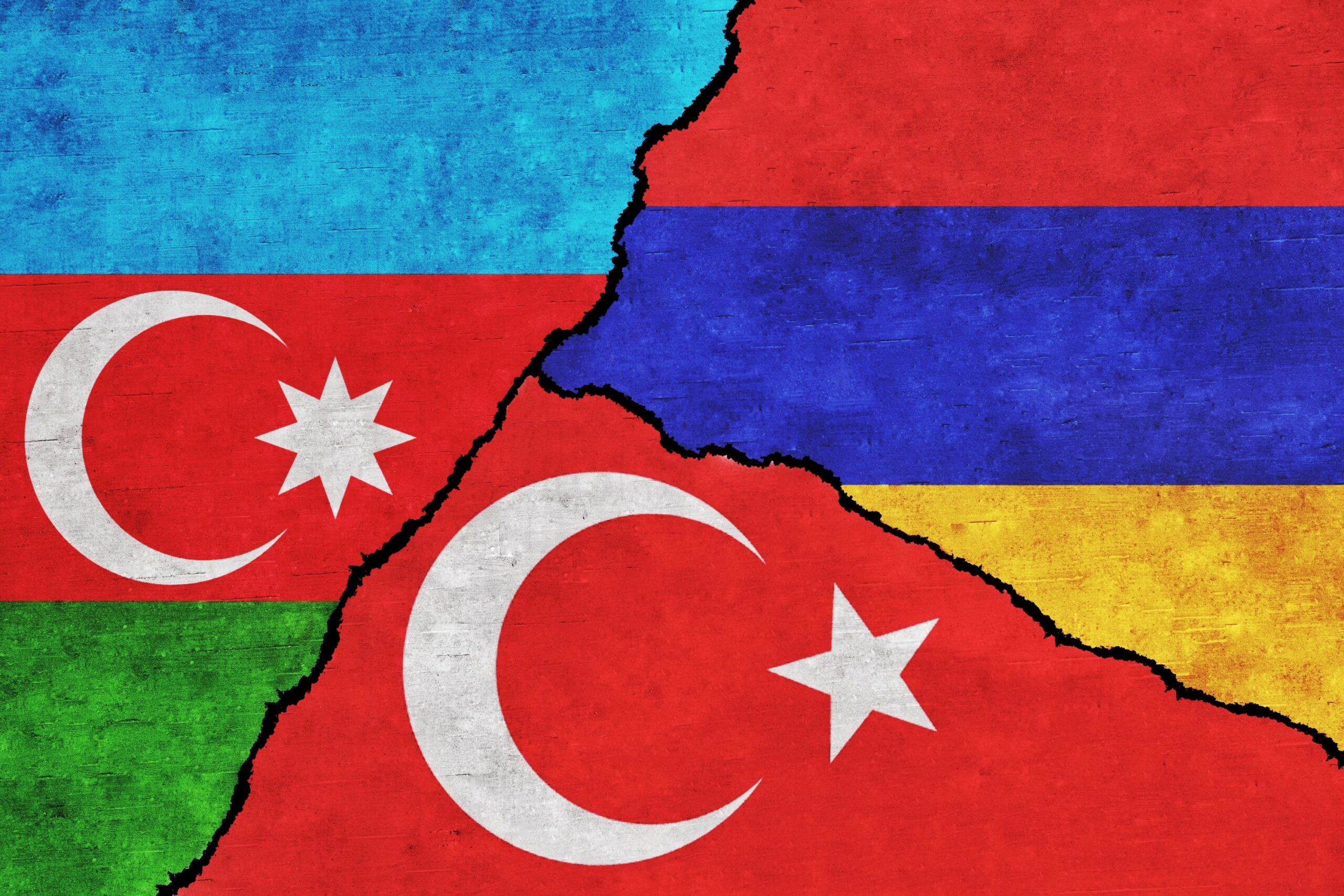
Rosie Betrossian, writes about the Armenia-Turkey-Azerbaijan triangular relationship and the geopolitical opportunity to defuse a frozen conflict.
Rich in resources, richer in history, the Caucasus is one of the most multifaceted and strategically fraught regions. The volatile land of the Caucasus acts as a land bridge connecting Europe, Asia and the Middle East. Most notably, however, the Caucasus serves as a geopolitical battlefield buffering different blocs: the West and BRICS and fueling its frozen conflicts with the Nagorno Karabakh, amongst others. The trilateral relations of Armenia, Türkiye, and Azerbaijan constitute a tangle of diplomatic and historical issues that seem impossible to untie through conventional diplomacy, presenting a Gordian knot. However, after decades of “soccer diplomacy” between the trilateral deadlock, a thaw is actively unfolding. With the offensive of Nagorno-Karabakh between Armenia and Azerbaijan, the longstanding legacy of the Armenian genocide in Armenian – Turkish relations, and the challenge of the constitutional changes, and Zanzegur corridor, the normalisation talks between Türkiye, Armenia, and Azerbaijan bring a glimmer of hope in the South Caucasus.
The Gordian Knot
Türkiye- Armenia
Wars are fought over oil, land, water, but rarely over history, especially about something that happened nearly 100 years ago. (1) Armenia and Türkiye are not at war; in fact, their relations are frozen. Ever since 1993, Türkiye and Armenia have had no bilateral relations due to the legacy of the ‘Armenian Genocide’. Türkiye has tactically resisted the recognition of genocide, using its NATO membership to apply economic and political influence on countries in the Middle East and elsewhere to hinder official acknowledgement. (2) Recognition of the genocide has been of grave international importance. When US President Biden recognised the 1915 mass murder of Armenians, Ankara perceived it as an act of betrayal, “groundless and unfair”, putting Turk-American relations in peril. (3) The fight over the recognition of genocide also functions as a symbol and a front for military alliances. Biden’s reputable recognition of the 1915 events in 2021 marked the official end of the US-Turkish alliance. This pushed Türkiye closer to Russia, with whom they’ve been developing a military relationship and a strategic partnership over Syria. The debate over the Armenian genocide can be deemed a symbol of the overdue thaw. Hence, it can be understood that the recognition of the genocide is not an independent issue. Instead, it functions as a pawn for policy and strategic alliances.
For Armenians, the 1915 genocide is not a closed chapter, but rather a ‘war on history’ and an ongoing injustice threatening the nation’s existence. Hence, recognition is seen as a moral and existential demand. Armenians believe that Türkiye must officially acknowledge the genocide and its historical responsibility to commence reconciliation. An important claim is that genocide denial nurtures a culture of impunity, allowing for future genocides (e.g., the Nagorno-Karabakh). Beyond moral considerations, Armenians view genocide recognition as a form of strategic necessity, particularly given Armenia’s geopolitical position. Landlocked, bordered by hostile or insecure neighbours – Türkiye and Azerbaijan – Armenia requires strong international support and recognition both militarily and culturally. International recognition is an imperative for Armenia’s national security and survival, strengthening its alliances. Armenians believe that Türkiye seeks to prevent potential legal consequences and financial reparations (4). At the same time, Türkiye’s active lobbying against the genocide acknowledgement and its influence in NATO render Armenia’s persistence unsustainable.
The recognition of the genocide is not an independent issue. Instead, it functions as a pawn for policy and strategic alliances.
Türkiye, on the other hand, does not officially recognise the 1915 events as genocide. The Turkish government acknowledges that large-scale suffering and deaths occurred during the collapse of the Ottoman Empire, particularly amidst the rise of the Young Turks and Turkification policies (i.e., Türkleştirme). Türkiye’s stance can be understood from the Zurich Protocols of 2009, (5) which detail a potential plan for the normalisation of bilateral relations with Armenia. It’s worth mentioning that the protocols omitted the conflict between Armenia and Azerbaijan over Nagorno-Karabakh in an effort to de-link the issues. However, Türkiye has made it clear that the normalization process, including the reopening of the border which closed in 1993 in solidarity with Azerbaijan, is contingent on Armenia’s posture in the South Caucasus, in the Nagorno-Karabakh region. Thus, recognition of the genocide is not merely an issue reliant on historical truth and accountability, but one shaped by alliances.
Armenia- Azerbaijan
The region is further knotted by its economic and strategic issues, as is precisely the case with the Nagorno-Karabakh. But why is this region so controversial? It is internationally recognised as a part of Azerbaijan, but historically populated by ethnic Armenians. Nagorno-Karabakh was an autonomous oblast (NKAO) (6) in the Soviet Union. In the collapse of the Soviet Union in the late 1980s, Armenians in Nagorno-Karabakh demanded unification with Armenia, inciting the war between Armenia and Azerbaijan. Other than the fight for self-determination and sovereignty, the region is close to the Azerbaijan-Turkiye oil and gas pipelines, making the stability there essential for energy security. (7)
In 1988-1994, full-scale war erupted during the soviet dissolution, resulting in Armenian forces controlling the region. The first Nagorno-Karabakh War concluded with a Russian-brokered ceasefire in 1994, which instigated the beginning of the OSCE Minsk Group and Russian intervention in the conflict. Despite ongoing mediation efforts by the OSCE Minsk Group, the situation remained a frozen conflict, with periodic outbreaks of violence, peaking in 2016.
Türkiye–Azerbaijan
Turkiye and Azerbaijan complicate the Gordian knot with their deep strategic alliance rooted in Turkic culture, language and religion, often described as a “One nation, two states” alliance. The phrase is originally rooted in deep ethnic, linguistic and historical ties dating back to 1918 when the Ottoman Empire was the first to recognise the independence of the Azerbaijan Democratic Republic. It was formalised with a treaty of friendship and cooperation the same year. The two states, however, share strong military, economic and political ties, and have taken on common projects like the TANAP pipeline (8) (southern Gas Corridor), which supplies gas to Europe. Their collaboration strengthens both nations’ positions in the South Caucasus, balancing other regional powers. An example is the significant Turkish investment in Azerbaijan’s construction, banking and trade volume. Even more, notably, their 2010 defence pact and joint military exercises demonstrate unified defence goals, with a common enemy – Armenia.
While no formal defence treaty between them exists, Türkiye acts as Azerbaijan’s security guarantor. Ankara’s visible commitment also serves as a deterrent mechanism, substituting for any written agreement. Moreover, Türkiye’s role in the region diminished the need for Russian or Western mediation, allowing Azerbaijan to rely on a trusted regional ally and strengthen the relationship. This is highly critical as Russia’s credibility as a regional security arbiter erodes. Finally and perhaps more pertinently, Turkiye has insisted that any normalization with Armenia must occur in coordination with Azerbaijan, granting Baku veto power over Ankara’s diplomatic engagement with Yerevan. This is a key structural feature in Turkish foreign policy in the South Caucasus and has been in place since the 2009 Zurich Protocols, further corroborating Türkiye’s security guarantee for Azerbaijan, highlighting the two countries’ strong alliance. (9) This epitomises the complexity of South Caucasus, as it basically reveals there are no bilateral relations without a hidden third influence.
Why Now? Why is Normalisation not only possible but also urgent?
The current momentum behind normalisation cannot be understood as a product of diplomatic goodwill or reconciliation. Rather, the post 2020 structures have dismantled the foundations behind the previous status quo. The 2020 Nagorno-Karabakh conflict changed the dynamics of the region. In September 19, 2023, (10) Azerbaijan initiated a swift military action, referred to as an “anti-terrorist operation,” against the self-proclaimed (11) Republic of Artsakh. This move came after months of humanitarian crises in the area caused by the blockade. Within a day, Armenian troops surrendered, resulting in Azerbaijan’s complete dominance over Nagorno–Karabakh. Subsequently, in 2024, the Republic of Artsakh was officially dissolved, marking the end of its unrecognized statehood, ending the 30-year de facto independence of the statelet. (12)
The offensive precipitated a mass exodus of ethnic Armenians, with over 100,000 fleeing to Armenia, effectively depopulating the region of its Armenian inhabitants. This development has been characterised as ethnic cleansing. Armenia and Azerbaijan engaged in peace negotiations, culminating in a draft agreement finalised in March 2025 (13). However, the treaty’s implementation faces hurdles over Azerbaijan’s demands for Armenia to amend its constitution to remove Nagorno-Karabakh and to dissolve the OSCE Minsk Group.
This new balance of power has made the pre-2020 status untenable. The model of frozen conflict, closed borders, and deferred diplomacy no longer corresponds to reality. Armenia’s isolation, once partially mitigated by control over Karabakh and Russian backing, has become strategically unsustainable. In this context normalization with Türkiye is not only an aspiration but a geostrategic necessity to reduce isolation, stabilize the western flank, and mitigate asymmetric pressure. Concurrently, Türkiye perceives the post-war environment as an opportunity to reshape the regional order. Azerbaijan’s victories have opened space for Ankara to assert itself as a central architect of South Caucasus security and connectivity.
The model of frozen conflict, closed borders, and deferred diplomacy no longer corresponds to reality.
Beyond security considerations, economic imperatives have intensified the urgency of normalisation. Armenia remains one of the most economically isolated states in the region, with closed borders to both Türkiye and Azerbaijan constraining trade, investment and growth. The blockade logic that once functioned as a tool of political pressure now imposes disproportionate costs on Armenia itself, particularly in the aftermath of war and displacement.
Reopening the Türkiye – Armenia border would provide Armenia with Access to regional markets, transit routes, and infrastructure projects linking Europe to Asia. These incentives have become more pressing as Armenia seeks to diversify its economic partnerships and reduce dependency on a narrow set of actors (Russia, Iran). (14)
For Azerbaijan, post-war consolidation has shifted priorities from territorial recovery to connectivity and corridor politics. Transport routes linking the Caspian basin to Türkiye and onward to Europe are viewed as a strategic extension of Azerbaijan’s sovereignty and economic leverage. Armenia’s acquiescence in these projects has therefore become a central component of Azerbaijan post war vision.
At the same time, the EU and the United States have demonstrated increased interest in South Caucasus stability, particularly in relation to energy security and transport routes that bypass Russia. Western support for normalisation reflects a broader preference for connectivity, further reinforcing the incentives for Armenia, Turkiye, and Azerbaijan to advance diplomatic engagement.
Limitations
However, perhaps the most challenging aspect of this tripartite knot is that, for normalisation between Türkiye and Armenia to occur, Azerbaijan and Türkiye demand changes to Armenia’s constitution. Specifically, the aim is to change the legal framing around Nagorno-Karabakh. Azerbaijan demands the removal of the preamble in the Armenian Constitution, that referencee the 1990 Declaration of Independence. This declaration is based on a 1989 joint decision for the “reunification” of the Armenian Soviet Socialist Republic and Nagorno-Karabakh, which Baku views as a violation of its territorial integrity. Türkiye has tied its own normalisation with Armenia to the signing of an Azerbaijan-Armenia peace deal. There are also implicit claims from Türkiye regarding eastern Türkiye provinces found in some Armenian national documents, linked with western Armenia. Armenia, however, is reluctant, arguing that the constitution is an internal matter and that Azerbaijan’s demand amounts to interference in its domestic affairs. Many citizens, including the nearly 150,000 displaced Armenians from Nagorno-Karabakh, view the proposed changes as “being forced on Armenia at the point of a gun” and a submission to Baku’s pressure, which is deeply unpopular and seen as a betrayal of their national identity. Moreover, from a legal perspective the Prime minister the constitutional court have pointed out that once a peace treaty is ratified it would have superior legal force over domestic legislation (Vienna Convention), hence a constitutional change is technically unnecessary to validate the peace agreement. In Armenia, any constitutional amendment requires a national referendum, and this high-stakes, controversial decision could potentially not gather enough public support, leading to a failed referendum. A rejected referendum could be framed by Azerbaijan as Armenian revanchism or obstruction of peace, potentially providing a pretext for renewed military action. While concurrently, Armenian opposition parties are trying to undermine the current government.
Moreover, the criticality of normalisation is driven by the interest the Zanzegur has received from the US, which would bring US dominance in the region. The “Trump Route for International Peace and Prosperity” (TRIPP) is a US-brokered proposal (2025) that shares similar ideas of connectivity but differs in control and operationalisation. The corridor is viewed as a crucial, irreversible and historical right to connect Azerbaijan with Nakhichevan and by extension Türkiye. Armenia opposes the “corridor” terminology and any route that operates without Armenian border checkpoints, favouring the “Crossroads of Peace” initiative, which ensures Armenian sovereignty over its territory. Essentially, Azerbaijan and Türkiye seek an unimpeded corridor with no checkpoints; Armenia strongly opposes any “extraterritorial” corridor that bypasses sovereignty. Other forces in the region, like Iran and Russia, are concerned about the US presence and potential loss of preexisting trade routes. Currently, Azerbaijan is finishing its side of the route, pushing for the link’s opening. The core ongoing debate is whether the route will have Armenian border checks or operate unchecked.
While a historic “thaw” in relations between Armenia, Türkiye, and Azerbaijan is currently unfolding, it is driven by geostrategic necessity rather than genuine diplomatic goodwill. The conflation of the post 2020 structures, the erosion of Russia’s credibility in the south and the swiftness of the Zanzegur development proclaim the exigency of normalisation. Despite major flashpoints in current negotiations, but there is grounded optimism for stability in the region.
Sources:
- www.cbsnews.com. (2010). Turkey and Armenia’s Battle over History – CBS News. https://www.cbsnews.com/news/turkey-and-armenias-battle-over-history/.
- Yacoubian, V. (2025). The politics of Armenian Genocide recognition and regional constraints in the Middle East. [online] The Armenian Weekly. Available at: https://armenianweekly.com/2025/04/30/the politics-of-armenian-genocide recognition-and-regional-constraints-in-the-middle-east/.
- Zharov, K. (2021). What Does U.S. Recognition of the Armenian Genocide Mean forTurkey-Russia relations? [online] Carnegieendowment.org. Available at: https://carnegieendowment.org/posts/2021/04/what-does-us-recognition-of-the armenian-genocide mean-for-turkey-russia-relations?lang=en.
- The Armenian Mirror-Spectator and The Armenian Mirror-Spectator (2021). Denial of theArmenian Genocide in Turkey as an Obstacle for Normalizing Relations withArmenia – The Armenian Mirror-Spectator. The Armenian Mirror-Spectator.https://mirrorspectator.com/2021/08/21/denial-of-the-armenian genocide-in-turkey as-an bstacle-for normalizing-relations-with-armenia/
- Toal, G. (2020). The fighting in Nagorno-Karabakh is about local territories and wider rivalries. [online] Revista de Prensa. Available at:https://www.almendron.com/tribuna/the-fighting-in-nagorno-karabakh is-about-local Territories-and-wider-rivalries/
- Wikipedia Contributors (2025). Zurich Protocols. Wikipedia. https://en.wikipedia.org/wiki/Zurich_Protocols?.
- Guardian News and Media. (2022, September 13). Why has fighting broken out between Armenia and Azerbaijan?. The Guardian. https://www.theguardian.com/world/2022/sep/13/why-has-fighting-broken-out-armenia-and-azerbaijan-nagorno-karabakh
- Turkish-Azerbaijani Energy Relations: Significant leverage … (n.d.). https://www.insightturkey.com/file/254/turkish-azerbaijani-energy-relations-significant-leverage-in-the-implementation-of-the-foreign-policy-interests-of-both-countries-spring-2015-vol17-no2
- Turkey and Azerbaijan: One nation – one State? (n.d.-a). https://www.imemo.ru/en/publications/periodical/meimo/archive/2022/2-t-66/countries-and-regions/turkey-and-azerbaijan-one-nation-one-state
- Landgraf, W. and Seferian, N. (2024). A ‘frozen conflict’ boils over: Nagorno-Karabakh in2023 and future implications – foreign policy research institute. [online] www.fpri.org. Available at: https://www.fpri.org/article/2024/01/a-frozen-conflict boils-over-nagorno-karabakh-in-2023-and future-implications/.
- www.aljazeera.com. (n.d.). Azerbaijan launches new military operation in Nagorno Karabakh. [online] Available at: https://www.aljazeera.com/news/2023/9/19/azerbaijan-launches-new-anti-terror offensive-in-nagorno-karabakh.
- Landgraf, W. and Seferian, N. (2024). A ‘frozen conflict’ boils over: Nagorno-Karabakh in 2023 and future implications – foreign policy research institute. [online] www.fpri.org. Available at: https://www.fpri.org/article/2024/01/a-frozen-conflict boils-over-nagorno-karabakh-in-2023-and future-implications/.
- 1 Hoory Minoyan (2025). Pashinyan’s peace agenda faces fire at home and on the frontlines. [online] The Armenian Weekly. Available at: https://armenianweekly.com/2025/05/14/pashinyans-peace-agenda faces-fire-at-home-and-on-the-frontlines/
- Armenia,Tripp Corridor, and Russia’s calculated risk. SpecialEurasia. (2026, January 28). https://www.specialeurasia.com/2026/01/28/armenia-tripp-corridor-russia/#:~:text=Key%20Takeaways,of%20Russian%20Railways%20(RZhD).
